Category Archives: Mis en valeur

6-STEPS TO GETTING MORE WEBSITE TRAFFIC

by Tim Kelsey and Aron Schuhmann

Marketing your business online is serious work that can make or break the success of a company. However, it is possible to master the basics yourself and start seeing tangible results without having to bend over backwards. But where do you start? Well, you need traffic.

Our comprehensive guide is for every business owner. You can drive more traffic to your site and inevitably convert new visitors into happy customers. Try our steps below to start on your journey to more website traffic, more customers, and more growth.

STEP 1: PUBLISH

DEMONSTRATE YOUR VALUE

Your great homepage content is not enough. To get sustained visibility and traffic, you need a regular stream of helpful and interesting content that visitors can easily find. How do you attract new visitors? Use your advantage as an expert and authority in your field.

Here are some types of content that help you (a) get found and (b) get your voice heard:

White Papers – These focus on a particular subject and/or industry vertical. White papers are specific, informative guides to help a user make a decision about your business. They’re a great opportunity to show the depth of your knowledge and expertise.

eBooks – Though similar to white papers in their focused content, ebooks tend to be longer, more comprehensive—and even entertaining if they have exciting designs. Drive leads from your traffic by giving ebooks away in return for contact information. Create a landing page with your ebook offer, and send traffic from your email and advertising campaigns to it. As long as you’re offering quality content, people usually don’t have a problem giving away their contact information in exchange for it.

step1_ebook

Blog articles – Blog articles are easy to produce and can help your site in multiple ways:

    • Content is the fuel for your internet marketing engine, and blog articles are a key source of content for any business. These articles can be shared on your social media profiles or in your email newsletters. If helpful enough, they can even end up being shared by others, allowing you to reach a much wider audience than you normally would.
    • They also help with SEO in a couple ways. First, the more topics you write articles about, the more long-tail keywords you’ll be able to optimize for. This means you’ll have more opportunities to rank for a wider variety of keywords which ultimately means that you’ll get more organic search traffic. Second, really great, helpful articles might end up earning inbound links from other websites. These links not only help that particular article rank in search engines, but also help strengthen the overall SEO of your domain.

step1_graph

  • Think of blog articles as investments in the long-term success of your website. The more you write, the more chances you’ll have for great conversations and tons of traffic. Not sure what to write about? Here’s a list of brainstorming tactics from Copyblogger, or you might try a tool like BuzzSumo to see what topics are popular in your industry.
  • Spend time writing a great title. The best copywriters agree: You should spend half of the entire time it takes to write a piece of persuasive content on the headline. 8 out of 10 people will read your headline, while only 2 out of 10 will read the entire article. A powerful headline ensure more people will continue reading the article.

“Your advantage in attracting new visitors is that you’re an expert and an authority in your field.”

Guest Post – Find one of the top publications in your field and send them an idea for a post, along with an introduction to your business and bona fides. Posting on someone else’s site will get your business in front of a new audience and in many cases, you’ll get an inbound link to your website. The important thing to remember: You shouldn’t guest post for the sake of earning inbound links. Write guest posts because you have something genuinely useful that you want to share with a larger audience.

Webinars – Webinars provide educational content to help your potential customers identify and solve their most common problems. Webinars often require registration which is an easy way to capture contact information and prospective leads.

Videos – You might think video production is too expensive for you to get into, but that’s not necessarily the case. As this guide from Wistia shows (or this one about shooting a high quality video on your iPhone), you can do video on a shoestring budget. When it comes to explaining complicated topics, videos can be much easier for your audience to digest than a dense blog article. They can also give you much-needed face time in front your prospects and clients, helping you build a stronger rapport with them.

  • A common misconception is that simply placing a video on a page will help that page rank better in search results—but this isn’t actually the case. Videos don’t have a direct impact on rankings, but they can help in indirect ways. As an inherently more shareable content medium, they can help you earn inbound links more often. And the higher level of engagement they encourage from website visitors can be a signal to search engines that your site providing a lot of valuable information.

Case Studies – These are specific examples of how your clients have directly benefited from your product or service. If possible, use exact data on how they benefitted. For example, if their revenue increased because of your service, add that information to the case study. Having a section on your website dedicated to case studies can help push those prospects who are on the edge of becoming new clients.

« Once you’ve produced a bunch of great content, don’t just let it sit there. You can reach a wider audience through promotion and outreach. »

Outreach – Don’t be afraid to link out to other resources in your content. When you do, send a message to the author of that resource letting them know you mentioned their work. Bloggers love getting this kind of exposure and will often times share your content with their followers on social media as a thank you.

Tools

  • BuzzSumo – Find popular topics
  • Wistia – Host your videos
  • DivvyHQ – Organize your content calendar
  • PowToon – Quickly create animated videos
  • Contently – Get connected with high quality freelance writers

STEP 2: SOCIAL MEDIA

CONNECT WITH YOUR AUDIENCE

Every social media network provides businesses with a profile. These profiles or « channels » are like free pieces of real estate for your business presence. Claim them now!

First, let’s look at basic rules to follow on all social networks:

Make sure your profile design is fresh, clean and up to date. Every once in a while, social networks will change their profile design requirements which can make your old banner and logo images appear pixelated or partial cropped. Keep an eye for notifications about these layout changes and make sure you prepare for them in advance.

Don’t be overly self-promotional. The social web is a place where people try to help each other—and entertain each other. Start your social sharing by posting content that your audience will actually find useful, like an article from your blog or another industry leader. The majority of your posts should be helpful to your fans and followers—with an occasional promo pushed in.

Always be writing. Content is what drives internet marketing. If your blog is empty or isn’t updated on a regular basis, you won’t have much to share on social media.

Create and post content worth sharing. While we’re discussing content, make sure that the content you write is actually something your audience will want to read and potentially share with their colleagues. Don’t just spin content that’s already been rehashed hundreds of times – write about your personal thoughts on current events in your industry or cover a topic that hasn’t received much discussion yet.

Add sharing buttons on your blog articles. Tools like AddThis make it easy to include sharing buttons on your content. Make is easy for your readers to share it on their favorite social networks.

addthis sharing buttons

Know which social networks fit your business. With a hot new social network popping up every couple months, does that mean you need to be joining all of them? Definitely not. Make sure the social networks you participate in fit your industry. Empty profiles look bad, so only join networks that you actually plan to use on a regular basis.

“Content is what drives Internet marketing.”

How to get the most out of your social profiles

Now that we’ve got the basics covered, let’s look at how you can leverage each of the largest social networks to gain fans, followers, and customers.

step2_facebook

Facebook

Getting a “like” on Facebook helps to grow your audience. Users who « like » your page can see your business’ posts in their newsfeed, but with users’ newsfeeds becoming increasingly crowded, you need to get maximum mileage from these posts with unique, appealing content. The result? Your post’s popularity can be rewarded with a higher visibility.

Here are important things to know about Facebook:

    • Visual content rules Facebook. A great image can take an uninteresting post and make it super shareable.
    • Make sure Open Graph attributes have been applied to your website. These snippets of HTML tell Facebook what image and text to include when a page or article on your site is shared.
    • Use Facebook’s ad platform to drive paid traffic to your website and landing pages. Depending on your industry, Facebook ads can be a great way to put your company in front of thousands of highly qualified people. Follow this guide to get started.
    • Target your ads with Custom Audiences. Facebook allows you to build ad audiences that are unique to your business. For example, you could set an ad to target a Custom Audience of only people that have already visited your website.

facebook custom audience

For the experts: If you’ve already had some success with Facebook ads, consider learning to use the Power Editor which gives you much more control audiences and ad variations.

step2_twitter

Twitter

Twitter is a neverending stream of short, punchy headlines. To get attention, your headlines need to be the punchiest—and also link to additional content on your website to drive traffic.

Here are key ways to use Twitter to your advantage:

    • Keep a running bank of enticing Twitter headlines, collecting ideas whenever inspiration strikes.
    • If applicable, add Twitter Card meta data to your blog articles. Similar to Facebook’s Open Graph data (although not as widely used), these HTML snippets tell Twitter how your page should be displayed when it is linked to in a tweet.
    • Include #hashtags on your tweets. Hashtags are used to link together posts regarding ongoing conversations about a specific topic. You can use a tool like hashtagify.me to see the most popular hashtags on Twitter. If one is relevant to your industry, jump into the conversation.
  • Interact with influencers in your industry. Followerwonk is a great tool that allows you to search profiles based on topics, then see how influential each of those users are. Building relationships with influencers can not only help you gain notoriety on Twitter, but can also help your business in unexpected ways.
step2_linkedin

Linkedin

With the addition of a publishing platform functionality, LinkedIn is now a content creator’s paradise, with an open feel and content-centricity.

Here are some ways to utilize LinkedIn:

  • Connect with all of your professional contacts. LinkedIn is the go-to social network for all business relationships. Don’t be afraid to connect with people you worked with at previous jobs or projects or even fellow alumni from your university.
  • Participate in a LinkedIn Group discussion. LinkedIn Groups are a great way to connect with like-minded individuals. Make sure you find a group that isn’t so large that you’ll get drowned out in the noise but also one that isn’t so small that it won’t have an impact on your potential traffic gains.
  • Create a LinkedIn Group. If you can find an existing group that fits your niche, don’t be afraid to start your own! Reach out to your connections and see if they’d like to join your new group.
  • Write articles for LinkedIn Pulse. Pulse is LinkedIn’s publishing platform which is open to all LinkedIn users. Think of it as guest blogging but with a potential audience of millions. Make sure you post helpful, valuable and unique articles that are specific to your field.
step2_googleplus

Google+

Google+ is Google’s social network, which helps Google capture important demographic information.

Here are tips for using Google+:

    • Complete your profile, and if you’re a local business, make sure you verify your location with Google. In order to do this, Google will need to mail a postcard to your business’s address with a PIN on it. You’ll then use that PIN to verify that your address is correct. Unverified businesses are much less likely to appear in local search results.
    • Join a Google+ Community. Similar to LinkedIn Groups, Google+ Communities focus on specific topics or niches. Find one that fits your business and start participating.
    • Host an interview or webinar on Google Hangouts. Hangouts isn’t just a way to chat with your friends. When used correctly, Hangouts can be a great source of content for you. Using ascreencasting tool like Snagit, you can record an entire conversation or presentation on Hangouts to be shared with your audience at a later date. Or if you’d rather have people participate in your webinar live, Hangouts on Air allows you to broadcast your presentation in real time.
  • Connect your website to your Google+ page with therel= »publisher » link attribute. This allows Google to verify your brand on Google+ and make a connection between your profile and your website.

How to improve your time management quickly

How to improve your time mangement quicklyWould you like to know how to improve your time management quickly? Don’t worry; most people are in the same boat. When trying to improve your time management, it is important to remember that there is no one size fits all solution. Each person presents their own unique challenges and if they really want to overcome their most serious time management challenges, they are likely to need more focused help. While the 7 steps below will not solve all time management problems, they will enable you to make steady and consistent improvements to your time management. I am confident that if you implement these 7 steps consistently, along with a regular time management review, you could easily save 1 month of working time per year.

How to improve your time management quickly

The 7 steps discussed below outline a process which can be used repeatedly to consistently improve your time management, allowing you to focus on your most important tasks and improve the quality of your results.

1. Become aware

If you wish to address a problem, you need to raise your awareness of the problem. Having a general idea of how bad things are is useful but if you want to create real and lasting change, you need to understand exactly where your time is going.

To gain an accurate account of how you are spending your time, you need to log your time. This works best with 15 minute increments e.g. upon completion of each task, record on your time log exactly how that each 15 minutes was spent i.e. if a task took 1 hour to complete, it should fill 4 increments on your time sheet.

2. Analyse your data

Once you have gathered sufficient data, at least 2 days but preferably 1 week; you can start to analyse your data to see patterns. Total the amount of time spent on each type of activity e.g. email, meetings, social media, time wasting activities. Once you have your totals, use an excel formula to calculate the percentage of your working time spent on each activity. Now, for each category of task, ask yourself the following:

  • ‘Am I happy with the amount of time that I am spending on this activity?’
  • ‘What percentage of time would I like to be spending on each activity?’

3. Identify tasks which are not necessary

When I work individually with clients, I usually go through their time log, one task at a time, and ask them to justify each task i.e. they must explain to me why the task is necessary. You would be amazed at how often I uncover a task which is being performed for no other reason than it has always been done. These tasks should be the first ones on the chopping block. Another great way to identify these tasks is to ask the following question for each task:

  • What would happen if this task was not completed?

We have been conditioned to think that everything must be done but when we examine each task individually we often find that failure to complete a task will have little or no consequence. I would argue that these tasks are generally not worth your time.

4. Identify the tasks which can be automated

With the advent of the internet, there are now many ways to automate tasks or at least bulk schedule them in advance. For example, with social media, you can use tools such as hootesuite or buffer to schedule in advance, or if you run a wordpress website, you can use a tool called Tweepi to automatically send your blog posts to Twitter e.g. I send a tweet every hour, every day of the week without ever having to type a tweet; this is a massive time saving. Other ways in which you can use automation to save time include:

  • Email autoresponders
  • Templates for commonly used documents
  • IFTTT recipes.

By having repetitive tasks at least partly managed by automation, the amount of time you can save is phenomenal. When I worked in New Zealand, the company for whom I worked used to produce a brand new document for each proposal. It took a great deal of effort for each proposal. Eventually, they started using a template which already contained the design and at least 50% of the content (a lot of content was repeated). This meant that a new proposal could be produced promptly.

5. Identify the tasks which can be delegated or outsourced

As I work alone, I do not have any colleagues to delegate to. Self-employed people often see delegation as an impossibility, for this reason. However, for the self-employed, delegation goes by another name i.e. outsourcing. There are many great websites on the web for outsourcing tasks which you do not enjoy, are not good at, or simply do not have the time to complete.

The site which I use most frequently is Fiverr. On Fiverr, you will find somebody to do just about any task for $5. There are some stupid gigs (that’s what they call the tasks) but there are many extremely useful gigs too. The person who provides the gig can usually do a much better job than you, as this is their area of expertise. You just pay your $5, give them instructions, and you will receive an email to notify when you need to review the finished gig. I have used Fiverr for such tasks as:

  • Logo design
  • Book cover design
  • Banner creation
  • Transcriptions

Any web based self-employed person should familiarise themselves with this site. Other useful sites for outsourcing include:

 6. Make gradual changes

Once you have eliminated, automated and delegated, you now need to focus on changing your working patterns. If you want to improve your time management, you need to take things slowly. Trying to make too many changes at once will result in disaster. Pick 2-3 small changes which will have a positive impact. Implement these changes and once they have been bedded in, make 2-3 more changes. The results will seem slower at first but over a period of time you will improve your time management exponentially, with lasting results.

 7. Right task, right time

Once you have made your initial time management changes, it is time to examine your energy levels and how to make the best use of them. It is important to note that your energy levels do not remain consistent throughout the day. You will experience peaks and troughs. One of the quickest ways to improve your time management is to assign your most important tasks to periods of high energy and your least important and easiest tasks to periods of low energy. This simple practice of switching tasks around will improve your time management by allowing you to complete your most important task quicker and more accurately by giving them your maximum energy.

You can learn excellent strategies to make rapid improvements to your time management in Quick Fixes for Your Productivity.

It is one thing to know how to improve your time management but if you really want to improve your time management, you will need to commit yourself to never ending improvement. The 7 steps, outlined above, will help you to make significant improvements to your time management but unless they are implemented regularly and applied with enthusiasm, the rewards will be short-lasting and you will soon slip back into your old ways.  An understanding of how to improve your time management is perhaps the most sought after information in the personal development, performance and stress management fields. The steps outlined above will not solve every problem but, if used properly, they will enable you to make giant strides forward. They will also enable you to identify areas which need more focused attention.

Image credit: Aleksandar Momirovic

WHY GOING OUTDOORS MAKES YOU SMARTER, STRONGER, AND MORE SPIRITUAL

3 Life-Changing Benefits of Nature You Can’t Afford to Miss

Whether we’re in our homes, in our cars, or in our offices, we spend most of our days removed from nature—and it’s not good for us.

iStock_000048485752_Large

Courtesy of iStock/lzf

I just returned from a fishing trip on the Big Horn River in Montana, and I’m on sabbatical right now in Maine. I live outside Nashville, Tennessee, and one thing we have in abundance is trees. But Maine has us beat. There are 22 billion trees here—almost 17,000 per person.

We all know about the environmental benefits trees and other plants provide. But how often do you take advantage of the mental, physical, and spiritual benefits we get from nature?

According to one article I recently read, “people today spend up to 25 percent less time enjoying nature than people did just 20 years ago.” Why does that matter? Because every day sheds new light on the benefits of being close to nature, and what we’re missing by staying indoors.

“We are influenced by our environment in ways that we are not aware of,” researcher Netta Weinstein says. In fact, experiencing nature can improve our minds, rejuvenate our bodies, and restore our spirits.

What Nature Does for Your Mind

Taking a break from the busyness of life to engage with nature, even for a few minutes, can bring big positive effects for our mental stamina and cognitive performance.

In one study, people performing memory and attention tests upped their scores by 20 percent after walking through an arboretum. Walking down a busy street, by comparison, offered no such benefit.

The time doesn’t have to be long. Short “micro-breaks” with nature, even just looking at pictures, has discernible benefits for our minds.

But long, immersive stretches in nature offer big benefits for our creativity and problem-solving skills. After spending four days in the wild, disconnected from any sort of digital technology, students performed 50 percent better on a problem-solving test. “Our results demonstrate that there is a cognitive advantage to be realized if we spend time immersed in a natural setting,” said researchers.

This is one of the things I love about my sabbatical time. I can feel my creativity welling up the longer I’m in the woods or by a stream.

And the positive mental effects don’t stop at brainy stuff like focus, creativity, and problem-solving. Nature improves our mood, generosity, and a lot more.

What Nature Does for Your Body

Spending time in nature is a great way to find physical rejuvenation. I always feel relaxed when I’m unplugged and outdoors.

It turns out the reason is that nature is a stress killer, which offers a cascade of other benefits, including:

  • Rejuvenated physical energy
  • Faster physical recovery
  • Reduced anxiety
  • Reduced muscle tension
  • Decreased stress hormones
  • Heightened immunity
  • Lower heart rate
  • Decreased blood pressure
  • Better cholesterol

Many of these benefits rebound to our mental health, of course, forming a virtuous circle.

We can look at these benefits like optional add-ons or upgrades to our lives. But the truth is they’re normative. We’re hardwired to spend time relaxing and resting, especially in natural environments.

Our locked-away, always-on, never-disconnecting way of living robs us of the rejuvenation God intended us to regularly experience.

What Nature Does for Your Spirit

To me, this is the most important. God created humans in the wild and placed us in a garden. We’re meant to live a substantial portion of our lives outdoors—and it’s a unique place to experience our Creator and restore our spirits.

The Bible says that nature speaks to us of God’s character and His attributes. Spending time in nature gives us a chance to slow down and notice what it’s communicating.

I’ve said this before, but God made us human beings, not human doings. You would never know it, looking at modern man. So much of our life is defined by our churning and turning through endless tasks and assignments. We’re so busy, we hardly take time to slow down and notice our hearts, notice God.

A long hike, fishing, wandering through a garden, walking along a stream—these activities let us disconnect from the crazy and get reconnected to our hearts.

Nature is God’s reset button for our minds, bodies, and spirits. If you’re spending all day indoors, you’re missing the restorative power of nature.

You don’t have to start with a sabbatical or weeks away from the office. You can start with a stroll. Just walking through the trees or napping in a park will help you realign, restore, and rejuvenate.

Question: How much time do you spend outdoors each week? What would it take to increase that? Share your answer on , , or .

Un recruteur vous demande des références, que dire?

Les recruteurs appellent souvent des personnes avec lesquelles vous avez travaillé pour prendre des renseignements sur vous. Attention à bien choisir les contacts.

Les recruteurs appellent souvent des personnes avec lesquelles vous avez travaillé pour prendre des renseignements sur vous. Attention à bien choisir les contacts.

REUTERS/Ralph Orlowski

Huit entreprises sur dix vérifieraient les contacts donnés par un candidat. Qu’en attendent-elles? Qui mentionner? Quelles sont les erreurs à éviter? Les réponses d’experts pour réussir cette étape.

94% des consultants et chasseurs de tête disent faire systématiquement le contrôle de trois des références données par leurs candidats, indique une étude du cabinet Oasys Consultants*. Ce serait aussi le cas de 80% des entreprises. Bien choisir les noms que vous allez donner est donc indispensable dans un processus de recrutement.

A quoi servent-elles?

La prise de références a deux objectifs pour le recruteur: « S’assurer de la véracité des informations données par le candidat, puis affiner la connaissance de la personne: éléments de caractère, types de réactions dans certaines situations », explique Pierre-Louis Letailleur, associé du cabinet de recrutement Amrop. « Par ce biais, il va vérifier ou valider les intuitions qu’il a eues face à un candidat », complète Isabelle Mounier Kuhn, directrice associée du cabinet Oasys Consultants.

Ce contrôle ne doit pas vous affoler. « Les recruteurs savent bien que personne n’est parfait, souligne Pierre-Louis Letailleur. Si nous cherchons à cerner les limites d’un candidat, c’est pour en donner une image réaliste à l’entreprise qui va l’embaucher. » La prise de référence aurait donc le même objectif que les questionnaires de personnalité: vérifier la compatibilité d’un candidat avec le poste, l’entreprise et l’environnement de travail.

Qui choisir?

« Les recruteurs contactent en moyenne trois références, préparez en cinq », suggère Isabelle Mounier Kuhn. Qui mentionner? L’idéal, ce sont les anciens N+1. « C’est ce qui est le plus sécurisant pour le recruteur », précise Pierre-Louis Letailleur. Quand c’est impossible (parce que le candidat est toujours en poste ou parce qu’il est parti en conflit), il faut expliquer pourquoi. Vous pouvez par exemple dire: ‘J’ai connu un différend avec mon N+1, dans lequel j’ai ma part de responsabilité…’, la transparence est importante pour nourrir le lien de confiance. » Il arrive en effet que le recruteur insiste pour pouvoir contacter votre N+1 malgré tout, mieux vaut qu’il soit prévenu d’un problème antérieur…

Vous pouvez aussi choisir un N+2, un collègue, un client, un partenaire, éventuellement un collaborateur… Tout dépend du type de poste en jeu. Un commercial a intérêt à mentionner un client, un expert technique peut citer un autre expert de son domaine. Un jeune diplômé peut donner le contact d’un enseignant… « Toute personne ayant autorité, c’est-à-dire qui a vu le candidat travailler, fonctionner et qui apportera au recruteur un approfondissement de la connaissance de celui-ci et une vérification d’informations », résume Pierre-Louis Letailleur. « Cela peut être aussi le RH, qui pourra parler de la manière dont le candidat se comporte dans l’entreprise », ajoute Isabelle Mounier-Kuhn.

Quand donner les contacts?

« Ne prenez pas l’initiative de donner des noms, conseille Pierre-Louis Letailleur. Proposer des références avant qu’on ne les lui demande met le candidat dans une posture de justification ou suggère un manque d’assurance susceptibles d’inquiéter. »

Les recruteurs laissent généralement du temps au candidat pour communiquer sa liste. Mais certains peuvent en demander dès le premier entretien. « Ils vérifient ainsi si on est au clair avec ses relations chez ses anciens employeurs, décode Isabelle Mounier-Kuhn. L’hésitation est alors suspecte. Ayez déjà votre liste prête, dès le premier entretien », suggère-t-elle. « Quand un candidat me parle de lui-même d’une personne avec qui il a travaillé, il m’arrive de lui demander ses coordonnées », dévoile Pierre-Louis Letailleur. Attention donc à n’évoquer que des personnes dont vous êtes sûr qu’elles ne vous nuiront pas si le recruteur les contacte.

Faut-il prévenir les personnes mentionnées?

Oui, par courtoisie, déjà! Il est bienvenu de demander aux contacts que vous donnez s’ils acceptent d’être sollicités. Mais l’enjeu est plus large. « En les appelant, vous avez l’occasion de leur faire un court argumentaire sur votre nouveau poste éventuel, explique Isabelle Mounier Kuhn. Ainsi prévenues, les personnes ne risquent pas de tomber des nues quand le recruteur les appellera, si ce nouveau poste n’est pas le même que celui que vous occupiez auparavant (‘Ce n’est pas du tout ce qu’il a fait chez nous!’). Elles auront tous les éléments en main pour argumenter de manière sereine. »

Six erreurs qui ne pardonnent pas

  1. Ne donner aucune référence d’une société où vous avez travaillé.
  1. Ne mentionner aucun hiérarchique.
  1. Communiquer le nom d’un hiérarchique avec qui vous avez été en conflit sans le mentionner au recruteur.
  1. Donner des références dont vous sentez qu’elles vous seront préjudiciables.
  1. Donner des références trop anciennes (au-delà de 8/10 ans).
  1. Renvoyer à vos recommandations sur LinkedIn. Les recruteurs risquent de les estimer biaisées. Ils préfèrent poser eux-mêmes leurs questions en direct.

* Etude de février 2014 menée par le cabinet de transition professionnelle Oasys auprès de 120 cabinets de recrutement et chasseurs de tête.

LEON COOPERMAN: I sent Obama an angry letter and then I got audited by the IRS

Leon CoopermanWall Street Week

In November 2011, billionaire hedge fund manager Leon Cooperman, the founder/CEO of Omega Advisors, sent an open letter to President Barack Obama detailing his issues with how the president had treated the nation’s wealthiest.Cooperman told « Wall Street Week » cohost Gary Kaminsky on Sunday that after he sent that letter he was audited by the Internal Revenue Service.

« You know, I got audited by the IRS, but I don’t know if there’s any cause and effect, » he said.

« I was just upset, » Cooperman said, explaining why he wrote the letter. « I felt the dialogue was unnecessarily destructive … Again, I’m not running for president. I don’t want to be president. I respect the president. He’s got a very difficult job. But I think that we should not pit the 99% against the 1%. »

Cooperman said his life should be used as an example for the younger generations.

He said he had lived the « American Dream. »

He grew up poor in the South Bronx. His parents were immigrants. He was educated in the public-school system. He was also the first generation in his family to graduate from college. He attended Hunter College in Manhattan and later graduated with his MBA from Columbia.

When he finished his education, he had no money, student-loan debt, a wife, and a six-month-old child.

He ended up going to work for Goldman Sachs. During his 25-year tenure at the bank, he became a partner and later CEO of Goldman Sachs Asset Management. After Goldman, he founded the hedge fund Omega Advisors, which now manages about $9.5 billion in assets, including $2.5 billion of his and Omega employees’ capital.

Cooperman now has an estimated net worth of $3.7 billion. He has also donated millions to charity and to his alma maters. Cooperman and his wife, Toby, a recently retired teacher who taught special-needs children in New Jersey for 25 years, have also signed Warren Buffett and Bill Gates’ « Giving Pledge. » He said he would leave all of his wealth to charity.

« I think that’s something to emulate, » Cooperman said on the show’s web extra series. « These youngsters can see what can be accomplished with some hard work and luck. »

Here’s the interview clip:

Here’s a copy of the letter he sent Obama:

OPEN LETTER TO THE PRESIDENT OF THE UNITED STATES OF AMERICA from Leon Cooperman.

November 28, 2011

President Barack Obama
The White House
1600 Pennsylvania Avenue, NW
Washington, D.C. 20500

Dear Mr. President,

It is with a great sense of disappointment that I write this. Like many others, I hoped that your election would bring a salutary change of direction to the country, despite what more than a few feared was an overly aggressive social agenda. And I cannot credibly blame you for the economic mess that you inherited, even if the policy response on your watch has been profligate and largely ineffectual. (You did not, after all, invent TARP.) I understand that when surrounded by cries of « the end of the world as we know it is nigh », even the strongest of minds may have a tendency to shoot first and aim later in a well-intended effort to stave off the predicted apocalypse.

But what I can justifiably hold you accountable for is your and your minions’ role in setting the tenor of the rancorous debate now roiling us that smacks of what so many have characterized as « class warfare ». Whether this reflects your principled belief that the eternal divide between the haves and have-nots is at the root of all the evils that afflict our society or just a cynical, populist appeal to his base by a president struggling in the polls is of little importance. What does matter is that the divisive, polarizing tone of your rhetoric is cleaving a widening gulf, at this point as much visceral as philosophical, between the downtrodden and those best positioned to help them. It is a gulf that is at once counterproductive and freighted with dangerous historical precedents. And it is an approach to governing that owes more to desperate demagoguery than your Administration should feel comfortable with.

Just to be clear, while I have been richly rewarded by a life of hard work (and a great deal of luck), I was not to-the-manor-born. My father was a plumber who practiced his trade in the South Bronx after he and my mother emigrated from Poland. I was the first member of my family to earn a college degree. I benefited from both a good public education system (P.S. 75, Morris High School and Hunter College, all in the Bronx) and my parents’ constant prodding. When I joined Goldman Sachs following graduation from Columbia University’s business school, I had no money in the bank, a negative net worth, a National Defense Education Act student loan to repay, and a six-month-old child (not to mention his mother, my wife of now 47 years) to support. I had a successful, near-25-year run at Goldman, which I left 20 years ago to start a private investment firm. As a result of my good fortune, I have been able to give away to those less blessed far more than I have spent on myself and my family over a lifetime, and last year I subscribed to Warren Buffett’s Giving Pledge to ensure that my money, properly stewarded, continues to do some good after I’m gone.

My story is anything but unique. I know many people who are similarly situated, by both humble family history and hard-won accomplishment, whose greatest joy in life is to use their resources to sustain their communities. Some have achieved a level of wealth where philanthropy is no longer a by-product of their work but its primary impetus. This is as it should be. We feel privileged to be in a position to give back, and we do. My parents would have expected nothing less of me.

I am not, by training or disposition, a policy wonk, polemicist or pamphleteer. I confess admiration for those who, with greater clarity of expression and command of the relevant statistical details, make these same points with more eloquence and authoritativeness than I can hope to muster. For recent examples, I would point you to « Hunting the Rich » (Leaders, The Economist, September 24, 2011), « The Divider vs. the Thinker » (Peggy Noonan, The Wall Street Journal, October 29, 2011), « Wall Street Occupiers Misdirect Anger » (Christine Todd Whitman, Bloomberg, October 31, 2011), and « Beyond Occupy » (Bill Keller, The New York Times, October 31, 2011) – all, if you haven’t read them, making estimable work of the subject.

But as a taxpaying businessman with a weekly payroll to meet and more than a passing familiarity with the ways of both Wall Street and Washington, I do feel justified in asking you: is the tone of the current debate really constructive?

People of differing political persuasions can (and do) reasonably argue about whether, and how high, tax rates should be hiked for upper-income earners; whether the Bush-era tax cuts should be extended or permitted to expire, and for whom; whether various deductions and exclusions under the federal tax code that benefit principally the wealthy and multinational corporations should be curtailed or eliminated; whether unemployment benefits and the payroll tax cut should be extended; whether the burdens of paying for the nation’s bloated entitlement programs are being fairly spread around, and whether those programs themselves should be reconfigured in light of current and projected budgetary constraints; whether financial institutions deemed « too big to fail » should be serially bailed out or broken up first, like an earlier era’s trusts, because they pose a systemic risk and their size benefits no one but their owners; whether the solution to what ails us as a nation is an amalgam of more regulation, wealth redistribution, and a greater concentration of power in a central government that has proven no more (I’m being charitable here) adept than the private sector in reining in the excesses that brought us to this pass – the list goes on and on, and the dialectic is admirably American. Even though, as a high-income taxpayer, I might be considered one of its targets, I find this reassessment of so many entrenched economic premises healthy and long overdue. Anyone who could survey today’s challenging fiscal landscape, with an un- and underemployment rate of nearly 20 percent and roughly 40 percent of the country on public assistance, and not acknowledge an imperative for change is either heartless, brainless, or running for office on a very parochial agenda. And if I end up paying more taxes as a result, so be it. The alternatives are all worse.

But what I do find objectionable is the highly politicized idiom in which this debate is being conducted. Now, I am not naive. I understand that in today’s America, this is how the business of governing typically gets done – a situation that, given the gravity of our problems, is as deplorable as it is seemingly ineluctable. But as President first and foremost and leader of your party second, you should endeavor to rise above the partisan fray and raise the level of discourse to one that is both more civil and more conciliatory, that seeks collaboration over confrontation. That is what « leading by example » means to most people.

Capitalism is not the source of our problems, as an economy or as a society, and capitalists are not the scourge that they are too often made out to be. As a group, we employ many millions of taxpaying people, pay their salaries, provide them with healthcare coverage, start new companies, found new industries, create new products, fill store shelves at Christmas, and keep the wheels of commerce and progress (and indeed of government, by generating the income whose taxation funds it) moving. To frame the debate as one of rich-and-entitled versus poor-and-dispossessed is to both miss the point and further inflame an already incendiary environment. It is also a naked, political pander to some of the basest human emotions – a strategy, as history teaches, that never ends well for anyone but totalitarians and anarchists.

With due respect, Mr. President, it’s time for you to throttle-down the partisan rhetoric and appeal to people’s better instincts, not their worst. Rather than assume that the wealthy are a monolithic, selfish and unfeeling lot who must be subjugated by the force of the state, set a tone that encourages people of good will to meet in the middle. When you were a community organizer in Chicago, you learned the art of waging a guerrilla campaign against a far superior force. But you’ve graduated from that milieu and now help to set the agenda for that superior force. You might do well at this point to eschew the polarizing vernacular of political militancy and become the transcendent leader you were elected to be. You are likely to be far more effective, and history is likely to treat you far more kindly for it.

Sincerely,

Leon G. Cooperman
Chairman and Chief Executive Officer

Read more: http://uk.businessinsider.com/leon-cooperman-audited-by-irs-2015-6?r=US#ixzz3cdvNJpv2

« Tu m’écoutes ? Alors répète ce que je viens de dire.»

« Tu m’écoutes ? Alors répète ce que je viens de dire. »  . Qui n’a jamais prononcé cette phrase ? A qui ne l’a-t-on jamais rétorqué ? Cette expression familière traduit tout d’abord, le sentiment que l’autre ne vous écoute pas vraiment et que vous êtes en attente d’un échange, d’une écoute. On pourrait largement transposer cette petite phrase dans un contexte professionnel, à ceci près que dans certaines situations, réunions, on se voit mal rétorquer à son interlocuteur               « Répète ce que je viens de dire » . Et pourtant, bien des situations seraient clarifiées car le besoin de reconnaissance des collaborateurs est criant en cette période .

La reconnaissance commence par l’écoute. Contrairement à ce que l’on pourrait croire, l’écoute est une compétence extraordinairement complexe à maîtriser. Presque toutes les relations que nous entretenons dans la vie courante nécessitent une écoute attentive et constante, et les relations avec les salariés n’échappent pas à cette règle.

Bien que l’environnement de travail subisse des évolutions,le besoin d’être écouté  des salariés demeure .

Les défis du management ne cessent d’évoluer. Il est incontestable que les outils dont nous disposons aujourd’hui pour analyser, piloter et gérer le personnel ont considérablement évolué ces dernières années – mais le personnel a changé lui aussi. Les personnes interagissent, communiquent et collaborent de façon différente et cette évolution n’est pas près de s’arrêter. Mais s’il y a bien une chose qui ne change pas, c’est la question « Est-ce que vous m’écoutez ? ». Une question que se sont posés, se posent et se poseront toujours les salariés.

Mais cette question est formulée de différentes façons. Certains salariés verbalisent suffisamment pour la poser directement, tandis que d’autres agiront ou d’autres encore agiront et parleront. Quoi qu’il en soit, vous devez savoir entendre ce qui est dit autant que les non-dits.

Rester connecté  avec ses équipes

Ce sont les capacités d’écoute d’une organisation qui lui permettront de savoir quoi faire pour maintenir la motivation de ses salariés. Il est absolument nécessaire d’écouter vos salariés, ce qui permettra notamment de faire émerger de nouvelles propositions de produits. En exploitant ces pistes vous comprendrez à quel point la valorisation de vos talents peut vous être utile.

Rester connecté avec votre personnel vous permettra d’établir un cadre idéal qui frisera la perfection. En effet, savoir collecter des informations ne vous aidera pas s’il n’existe pas un bon climat de confiance. Vos salariés doivent recevoir une écoute et une réponse à leur problématique. Ils doivent recevoir une écoute et un message clair: « Oui, nous vous écoutons en nous efforçant de bien vous comprendre et en nous investissant pleinement dans chaque conversation”. Tous les salariés doivent obtenir ce type réponse, et pas uniquement quelques privilégiés. Pour découvrir la solution RH innovante Oracle HCM Cloud qui permet un échange et une écoute continue de ses salariés, cliquez ici .

La fin de l’ère Coca-Cola

Un long déclin s’amorce pour le géant mondial du soda, qui peine à s’adapter aux changements profonds des habitudes de consommation.

Trop souvent ces derniers mois, les journaux ont eu raison de titrer « Coca Cola perd de son peps ».

En mars, Beverage Digest a annoncé que PepsiCo avait pris la deuxième place du marché des boissons gazeuses aux Etats-Unis, devançant Coca-Cola sur son marché historique. Depuis 2010, Coca-Cola light occupait cette deuxième place en termes de volume. Pepsi l’a détrôné, illustrant par là le désamour croissant des Américains pour les sodas light. Ce revirement intervient à un moment où laconsommation de boissons gazeuses par les Américains est à son niveau le plus bas depuis les années 80.

Le long déclin d’une marque mondiale. © Flickr CC/Beverley Goodwin/Business Insider

Avant la publication de ce rapport, Coca-Cola avait annoncé que son bénéfice net attribuable aux actionnaires avait plongé de 55% au quatrième trimestre, tombant à 770 millions de dollars. Le résultat opérationnel net de la marque a chuté de 2% au cours du même trimestre, à 10,9 milliards de dollars bien que les ventes mondiales aient légèrement augmenté sur l’année. Les ventes en Amérique du Nord ont connu une croissance modeste pour la première fois en un an.

L’horizon à long terme est encore plus sombre. En 2014, le chiffre d’affaires global de Coca-Cola était de 46 milliards de dollars, en baisse de 4% (2 milliards de dollars) par rapport à 2012.

Cette tendance à la baisse n’est pas due à un événement soudain et/ou majeur.Comme l’explique le rapport de Beverage Digest : « Le volume des ventes de Coca-Cola était légèrement en hausse l’an dernier (0,1%). L’entreprise était sur une pente ascendante après plusieurs années de déclin. L’année 2000 a vu sa dernière croissance en date. » (Souligné par l’auteur).

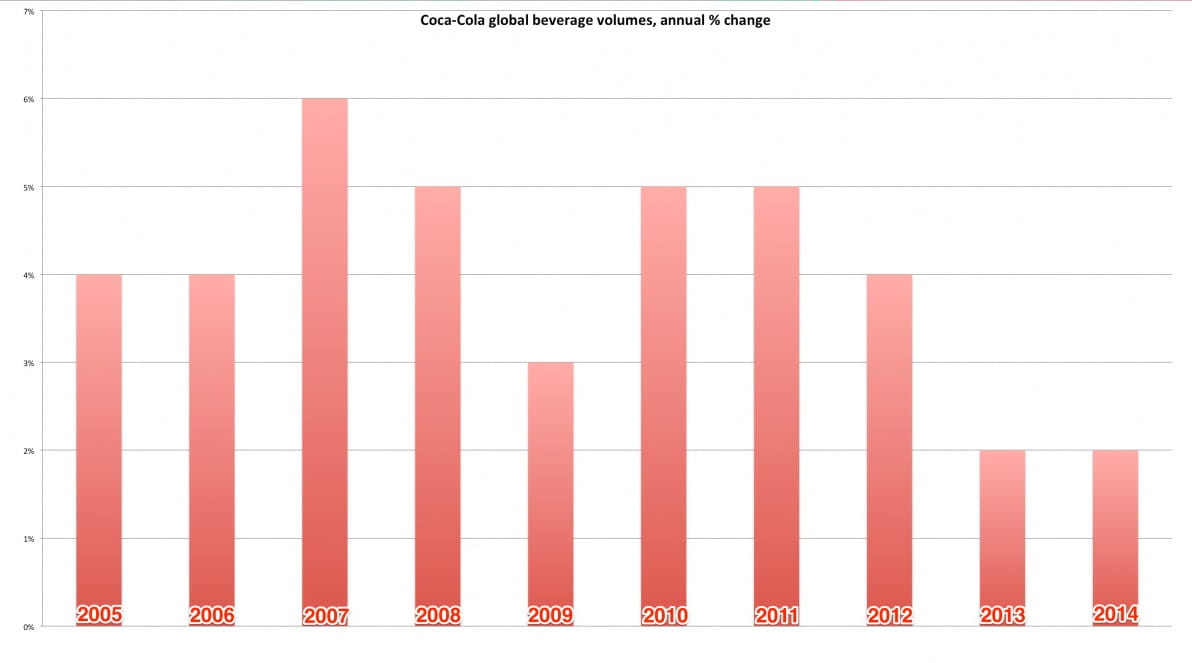
Au niveau mondial, cela fait deux ans que l’entreprise n’atteint pas ses objectifs de 3 à 4% de croissance en volume annuel, comme le montre ce graphique réalisé sur la base de données collectées sur le site The Wall Street Journal.

Taux de croissance en volume des ventes mondiales de Coca-Cola.  © Coca-Cola/The Wall Street Journal/Business Insider

Ce phénomène ne touche pas uniquement la marque Coca-Cola mais l’ensemble du marché des boissons gazeuses aux Etats-Unis. Toute l’attention se porte sur Coca-Cola car c’est le leader du secteur. Des décennies s’écouleront encore avant qu’on ne commence à parler de Coca-Cola comme on parle de Kodak. Cette phase finale pourrait même ne jamais arriver. Néanmoins, si le groupe ne prend pas de dispositions stratégiques rapidement, ce pourrait être la fin d’un marché très mature.

À l’heure actuelle, Coca-Cola est en passe de rendre l’âme. Pas en fanfare mais dans une longue et lente agonie.

Le PDG de Coca-Cola, Muhtar Kent, a déclaré que 2015 serait une « année de transition », et qu’il espérait que le plan de 3 milliards de dollars d’économies annoncé en octobre porterait ses fruits « dans un contexte macroéconomique incertain et fluctuant. »

La « transition » que Kent attend est déjà visible dans certaines des politiques les plus récentes de Coca-Cola : l’entreprise a demandé à 10 agences marketing de proposer des idées pour sa prochaine campagne publicitaire mondiale. En Europe, l’emballage est désormais unique pour toutes les saveurs, et des coupes ont été faites dans le budget marketing des marques Coca-Cola light et Coca-Cola zéro. Les efforts marketing seront à la place concentrés sur le Coca-Cola traditionnel en Amérique du Nord (d’autres produits apparaîtront toujours dans les publicités mais il n’y aura plus de campagnes individuelles comme celle mettant en scène des mannequins masculins pour Coca-Cola light).

Tandis que les ventes continuent de chuter au fur et à mesure que les consommateurs changent leurs habitudes, se tournant vers des boissons plus saines (le portefeuille de produits ultra-sucrés de la marque Coca-Cola explique en partie pourquoi elle est décriée par la presse), on peut se demander si les changements nécessaires en termes de marketing arrivent trop tard. Peuvent-ils réellement sauver la marque d’un déclin total ?

« Le règne de Coca-Cola à la tête des marques mondiales est fini pour toujours »

Quelles que soient les statistiques que l’on regarde, Coca-Cola semble toujours perdre de sa valeur.

Ces dernières années, la marque est sortie du top cinq du classement annuel de BrandZ « les 100 marques les plus valorisées », remplacée par des entreprises IT. McDonald’s a subi le même sort. Coca-Cola est quand même mieux placé dans le classement annuel d’Interbrand, à la troisième place l’an passé derrière Google (deuxième) et Apple (premier). Selon Mark Ritson, professeur associé de marketing à la Business School de Melbourne, consultant en stratégie de marque et journaliste pour Marketing Week, il est peu probable que Coca-Cola domine à nouveau ces classements.

Il nous a déclaré : « Coca-Cola sera toujours le leader du cola jusqu’à la fin des temps. Mais la valeur de ce produit est amenée à s’effondrer ces 20 prochaines années. Il ne fait pas bon être un gros poisson dans une mare de plus en plus petite. Le règne de Coca-Cola à la tête des marques mondiales est fini pour toujours. »

Et pour en revenir aux mutations des habitudes alimentaires qui continuent de s’étendre, Ritson ajoute : « Les produits naturels, les ingrédients bio, frais et locaux étaient, à l’origine, le credo de petits groupes de consommateurs avertis. Cette tendance est devenue de plus en plus forte dans les pays développés ces dernières années. Et elle ne fera que s’accentuer à l’avenir. Le succès indéniable et la domination de Coca-Cola au 20e siècle ont aveuglé le groupe qui n’a pas vu la transformation du marché au 21e siècle ce qui le laisse soudainement vulnérable au changement. »

Vers une stratégie de marque unifiée

La politique de Coca-Cola en Europe de créer une campagne marketing unique pour toute sa gamme, plutôt que présenter chaque produit séparément, a des avantages évidents : clarifier auprès des consommateurs son portefeuille de produits en constante évolution, détourner l’attention des produits mauvais pour la santé vers des variantes avec peu ou pas de calories et diminuer les coûts.

Coca-Cola nous a affirmé que le but n’était pas de diminuer les investissements marketing (au contraire, la marque prévoit d’investir d’avantage dans la marque Coca-Cola en Grande-Bretagne, par exemple), mais il ne fait aucun doute que des économies seront réalisées dans les secteurs en transition.

Nous avons demandé ce qui allait arriver aux brand managers et aux responsables marketing qui travaillent sur des produits spécifiques comme Coca-Cola light ou Coca-Cola zéro. Une porte-parole nous a déclaré que l’entreprise procédait à une réorganisation globale qui concernerait 1 600 à 1 800 postes dans la filiale nord-américaine, et dans l’ensemble des filiales internationales mais il est encore trop tôt pour dire combien de postes seront concernés en Europe.

Cette stratégie de marque unifiée pourrait être très bien acceptée en Amérique du Nord et également dans d’autres marchés importants. Le résultat des pitchs de ses agences de pub sonnera probablement le glas du slogan « Ouvre un Coca-Cola, ouvre du bonheur » qui aura duré six années et marquera un nouveau virage créatif pour le produit phare de la marque.

Coca-Cola va lancer une campagne marketing unique pour toute sa gamme afin de réduire les coûts et de clarifier son portefeuille de produits

Dans un communiqué, le groupe a déclaré : « Nous avons demandé à certaines de nos meilleures agences marketing de mettre tout leur talent au service de notre marque phare. Nos agences de pub et nous-même nous efforçons de délivrer des messages créatifs et amusants qui interpellent et impliquent tous nos consommateurs et qui génèrent de la croissance. Cette volonté nous aidera à exploiter les plus brillants esprits des agences marketing pour atteindre le meilleur travail possible. »

Selon Elspeth Cheung, directrice du département évaluation chez BrandZ, la récente campagne publicitaire de la marque pour fêter le 100e anniversaire de sa légendaire bouteille Contour, qui consistait à ouvrir des boutiques éphémères au décor rétro dans de grandes villes américaines et à afficher largement des panneaux publicitaires mettant en scène des icônes telles que Elvis Presley et Marilyn Monroe, montre que le pouvoir du produit phare est encore bien présent.

Elle a ajouté : « Il y a peu de marques qui peuvent rivaliser avec Coca-Cola à ce niveau-là. Tout vient de la tradition entourant le légendaire Coca-Cola. Si une chose est capable de faire revivre l’entreprise, c’est ce produit qui est le plus reconnu au monde. »

Cependant, elle nuance : « Je conseillerais au PDG de ne pas trop se focaliser sur l’avantage financier que représente l’utilisation unique de sa marque principale. Les recherches de BrandZ montrent que les fabricants de produits tels que la bière et les voitures qui ont mis l’accent sur les avantages opérationnels d’économies d’échelle ont rendu leurs marques moins uniques et moins reconnaissables. »

Coca-Cola ne doit pas s’arrêter aux campagnes publicitaires, mais considérer également leurs répercussions pour accompagner son revirement.

Jamal Benmiloud, ancien vice-président du marketing chez Monster Energy (et ancien responsable marketing Grande-Bretagne chez Red Bull), désormais fondateur et concepteur en chef de l’agence de marketing EARN pense que Coca-Cola a le pouvoir de changer l’opinion non seulement par sa méthode de communication mais aussi par une approche commerciale différente.

« Coca-Cola devrait faire en sorte d’être aimé comme Lady Di était aimée »

« Je pense que la direction de Coca-Cola a la possibilité de respecter les valeurs de la marque et d’apporter plus à la société. Ce processus pourrait créer une réaction négative, et alors ? Il s’agit de faire ce qui est bien. Coca-Cola devrait être la marque la plus divertissante du monde, la plus attendue, et également la plus aimée, de la même manière qu’une personne aime Lady Di, en s’engageant et en faisant la différence. Coca-Cola a le pouvoir de faire des choses incroyables sur cette planète », estime Benmiloud.

Un bon exemple, c’est le projet de Coca-Cola, en partenariat avec des œuvres caritatives, de partager son expertise en termes de logistique et de chaîne dedistribution pour faire parvenir des médicaments de base à des villages africains très reculés. « Il faut davantage de gestes de solidarité, nous avons besoin de voir plus de preuves d’amour », ajoute Benmiloud, co-auteur du livre paru récemment « Brand Love : How To Build A Brand Worth Talking About« . Selon lui, Coca-Cola a la capacité de financer d’autres initiatives de ce genre.

« Vision 2020 » de Coca-Cola

Un des éléments qui caractérise le mandat de Muhtar Kent à la tête de la marque, ce sont ses prévisions à long terme pour l’entreprise. En 2010, il a tracé les grandes lignes de la « Vision 2020 » de Coca-Cola, bâtie autour de six tendances socio-économiques qui, il l’espère, aideront la marque à doubler son chiffre d’affaires d’ici 2020. D’autres stratégies ont également des objectifs à long terme, comme l’ambition de faire faire plus de sport à 1 million de Britanniques sur cette même période.

Coca-Cola doit maintenir le plus possible ses ventes de cola tout en cherchant en urgence un moyen de se diversifier

Benmiloud ajoute : « Une des particularités de Coca-Cola qui m’impressionne vraiment, c’est son implication à long terme. La marque traverse peut-être une passe difficile en ce moment mais elle continue de bâtir des projets sur 5, 15, 20 ans pour développer encore l’entreprise… Je pense que Coca-Cola est à un tournant de son histoire. Nous verrons ce que la marque décidera pour les cinq prochaines années, et ce qu’elle fera pour conserver l’enthousiasme du monde et de ses partenaires jusque-là. »

La diversification sera cruciale si Coca-Cola veut s’adapter aux changements permanents des habitudes de consommation, et l’entreprise est déjà en train d’y travailler. En début d’année, elle a par exemple lancé aux Etats-Unis un lait « premium » appelé Fairlife. L’année dernière elle a déboursé 2,15 milliards de dollars pour une participation de 16,7% dans Monster Energy afin d’étendre son influence dans le marché de la boisson énergisante. Et en 2013, Coca-Cola a augmenté sa participation dans la marque de boissons Innocent à presque 100%dans une tentative de consolidation de sa présence sur le marché européen des smoothies et des jus de fruits.

Mais la marque a encore du chemin à faire selon Ritson : « PepsiCo est dans une position de force par rapport à Coca-Cola car moins de la moitié de ses bénéfices mondiaux dépendent des boissons gazeuses, comparé à 75% pour Coca-Cola. C’est la preuve criante d’un problème à régler de toute urgence. Coca-Cola doit maintenir le plus possible ses ventes de cola et accompagner le déclin autant que faire se peut tout en cherchant en urgence un moyen de se diversifier et d’acquérir de nouvelles marques adaptées aux attentes des consommateurs du 21è siècle. »

L’ère Coca-Cola telle que nous la connaissons est certainement terminée. Mais une nouvelle ère, plus variée est sur le point de s’ouvrir.

7 free tools for anyone who wants to become a better writer

42-26214828
IMAGE: CORBIS IMAGEZOO

The awesome (and scary) thing about being a writer is that you can always improve. It’s why people can sit on a draft for weeks — every time they take « one more look, » they can find a way to make it better.

While it’s definitely a fun challenge to see how long you can keep finessing your work, it’s not always practical. After all, your boss usually doesn’t want you working on that press release for weeks on end while you try to brainstorm the perfect opening line.

Thankfully, there are plenty of resources out there that can speed the editing process up and make you more confident about the work you’re submitting. For today, I went though Product Hunt’s newest Tools for Writers collection and chose my seven favorites. Use them all, and you’ll be a stronger writer faster than you can say, « How did I ever live without these? »

1. Grammarly for Chrome

17425

As much as Microsoft Word’s AutoCorrect function annoys us, we must admit to missing those green and red squiggly lines when we’re writing online. Finding our own spelling and grammar mistakes isn’t always easy.

Enter: Grammarly (for Chrome users). Whether you’re crafting a message in Gmail, writing a Facebook post, or tweeting your latest mood, Grammarly helps you catch errors before they go live. In addition, its contextual spell-checker will save you from mixing up commonly confused words, so that you don’t embarrass yourself in that email to the higher-ups.

2. Hemingway

17427

If you struggle with being long-winded, Hemingway could be a game changer. The app helps you become a bolder, clearer, and more concise writer. Just open it in any browser, paste writing directly into the white space, and let Hemingway do its magic. As the screenshot above indicates, sentences that need different types of editing (think: simplifying the structure or eliminating passive voice) will be color-coded accordingly.

Hemingway doesn’t stop there — it also features a readability meter that tells you how difficult it is to comprehend your writing. If you’re aiming to deliver a succinct message, anything above « Grade Level 10 » is, according to Hemingway, way too complicated.

3. Writepls

17428

Searching « best writing advice » on Google will, sadly, not always bring you the best writing advice. That’s why Writepls exists. The founder, Mark Marchenko, realized that even though thousands of writing-related articles are on the web, only a few are worth reading. So, to save you time, Writepls selects and sends the gems straight to your inbox.

The articles are currently grouped in four categories, and topics range from personal testimonials like « How I Cut My Writing Time From 2 Days to 4 Hours » to listicles like « The Ten and a Half Commandments of Writing. »

4. OneLook Reverse Dictionary

17433

I’m sure you’ve experienced the frustration when you have a word in mind but can’t quite remember it. OneLook’s Reverse Dictionary is committed to making sure that you never have to go through that again. After you search the concept you’re thinking of, Reverse Dictionary gives you a list of words and phrases related to it. And, chances are, the results will give you the word you were thinking of — plus better alternatives.

In my demo above, for instance, I searched up « urge to travel, » hoping to pinpoint the word « wanderlust. » But I found that answer #15, « itchy feet, » is the less cliché term I wanted to use.

5. Daily Page

17430

A daily habit is great, but what’s even greater is a daily habit that unlocks your creativity. And there’s no better way to unlock your creativity than by writing. If you think I’m talking about spending an hour every day to write about some highly debated issue, think again (who has time for that?). No, I’m talking about receiving a fun prompt every morning from Daily Page and answering it in one to two casual paragraphs before the end of the day.

Past prompts have included « describe your worst heartbreak, » « describe three qualities you admire from three different individuals, » and « I messed up… » As you write, you can decide whether to keep your response private or to share it with fellow Daily Pagers. Even if you select the first, you’ll have full access to public responses and can immerse yourself in other writers’ creative answers.

6. buffalo

17431

If you’d like to go beyond writing daily exercises and publish your thoughts online, buffalo could be the app for you. I know you’re wondering why in the world we need another blogging platform when existing ones like Medium and Tumblr are perfectly functional (and they are!). But buffalo is different because you don’t see other users’ content or excessive buffalo branding in your post.

If you’ve always wanted to become a better writer and are hoping to build a strong writing portfolio, consider trying it out. This tool is especially useful for any aspiring author who doesn’t have time to create a full-on personal website.

7. Reedsy

17432

Finally, if you’re serious about writing professionally, check out Reedsy — the marketplace that connects you with the best publishing professionals (think editors, cover illustrators, and marketers) and helps you create high-quality e-books. If you’re an aspiring author and are stuck after writing your first draft, Reedsy provides all the necessary services that will help you transform it into a published work.

Know of other useful writing apps that aren’t included here? Let me know about them on Twitter!

La reprise d’entreprise en quête d’un nouveau souffle


Transmission / Chaque année, des entreprises disparaissent faute de trouver un repreneur

« Entreprise en bonne santé cherche repreneur désespérément ». Voilà une petite annonce qui pourrait se retrouver sur Le Bon Coin, tant la transmission-reprise est un marché complexe. Car il existe bien des candidats à la reprise, de même que des PME à reprendre. Encore faut-il faire se rencontrer ces deux besoins…
Actuellement, trois grandes bases de données couvrent une bonne partie du marché : Fusacq, le CRA (Cédants et Repreneurs d’Affaires) et TransPME. Cependant, ce n’est ici que la partie immergée de l’iceberg et une large part des transactions passe par un marché plus confidentiel, voir caché, notamment pour des raisons de confidentialité.
« Le grand challenge des prochaines années est bien la transmission d’entreprise, avance Stéphane Cohen, président de l’Ordre des Experts-Comptables Paris Ile-de-France. On estime que 500.000 entreprises ne trouvent pas de repreneurs, ce qui illustre bien l’impasse dans laquelle nous sommes sur ce point. Les conséquences sont lourdes, avec des cédants qui se voient contraints de rester à la tête de leur entreprise, de trouver un repreneur dans l’urgence, ou encore, souvent, de fermer l’entreprise. Avec pour conséquence des licenciements… La cause ? Un manque de fluidité de ce marché ! »

Manque de données… et de conseils

Si les grandes entreprises sont conseillées par  des banquiers d’affaires, avec un marché de l’offre et de la demande bien organisé et de nombreux intermédiaires, pour les entreprises réalisant moins de 2 à 3 millions de chiffre d’affaires, en revanche, il y a un creux du marché du conseil. « Un de mes clients est dans  cette situation, prêt à une opération de croissance externe… mais qui se trouve confronté au problème de l’identification d’une entreprise à reprendre, illustre Stéphane Cohen. Il n’existe aucun outil pour l’aider dans ce genre de démarche. Or, nous pensons qu’un des interlocuteurs naturel de ces entreprises, c’est l’expert-comptable. »

Des outils pratiques pour guider les chefs d’entreprise et repreneneurs

C’est dans ce contexte que plusieurs initiatives émergent depuis quelques temps afin d’épauler tout à la fois les chefs d’entreprise, les candidats à la reprise mais aussi les professionnels chargés de les conseiller. Parmi ces dernières, la création début 2015 du réseau « Transmettre & Reprendre », réunissant l’Agence pour la création d’entreprises (APCE), l’Assemblée permanente des chambres de métiers et de l’artisanat (APCMA), Bpifrance, CCI Entreprendre en France, le Conseil national des barreaux (CNB), le Conseil supérieur du notariat (CSN) et le Conseil supérieur de l’ordre des experts-comptables (CSOEC). Parmi ses missions, le développement de l’information via des outils pratiques et des événements. L’APCE  a également lancé prediagentreprise.fr,une aide en ligne gratuite à la transmission/reprise d’entreprise. Cet outil interactif, développé avec le concours du réseau des Chambres de commerce et d’industrie, permet de réaliser un prédiagnostic de transmissibilité d’une entreprise. Il s’adresse tout autant aux professionnels de la transmission/reprise qu’aux cédants et repreneurs d’entreprises.  L’objectif ? Identifier en un clin d’œil, toutes les forces et faiblesses du projet de transmission.

Les experts-comptables d’Ile-de-France,  associés aux notaires et aux commissaires aux comptes, organisent eux depuis quelques années les Journées de la Transmission d’entreprise à Paris(qui se tiendra cette année en novembre). Aujourd’hui, ils souhaitent même aller plus loin : « Nous réfléchissons à la création d’une plate-forme d’intermédiation. L’idée serait de créer une sorte de « Meetic » de la transmission», lance Stéphane Cohen. Cette plateforme, d’abord testée auprès  des entreprises d’Ile de France clientes des cabinets, pourrait à court terme s’étendre pour couvrir l’ensemble du territoire.

Quel intérêt pour un PDG ou dirigeant d’être présent sur les réseaux sociaux ?

Les réseaux sociaux représentent un excellent moyen marketing pour donne de la visibilité à votre entreprise. La plupart des dirigeants ont bien compris que leur société devait opter pour une stratégie social media, mais 68% n’y sont toujours pas présents eux-mêmes ! Ce chiffre est étonnant et plutôt paradoxal, d’autant plus que l’envie de proximité et que l’attente d’humanisation se manifeste dans le comportement des consommateurs auprès des marques.

Dans un environnement digitalisé, il est évident qu’un chef d’entreprise aurait tout intérêt à gérer son personal branding grâce à une présence à titre personnel sur les réseaux sociaux. En fonction de la taille de votre entreprise, l’ensemble de ces réflexions s’applique également aux cadres de haut de niveau qui peuvent représenter votre marque.

Se vendre pour mieux vendre son entreprise

Un bon chef d’entreprise doit savoir se vendre lui-même, pour espérer vendre ses produits et services sur internet. En tant que dirigeant, vous êtes le premier ambassadeur de votre société auprès de vos clients, mais aussi de vos salariés et collaborateurs. De ce fait, lorsque vous créez un profil professionnel sur un réseau social, vous donnez l’opportunité à l’ensemble de ces acteurs d’identifier votre entreprise à travers votre personnalité.

Le professionnalisme que vous démontrez au travers de votre profil personnel permet de vendre l’image de votre marque, ainsi que votre propre expertise, ce qui permet de rassurer vos clients et d’en attirer de nouveaux, tout en faisant ressortir le côté humain, essentiel pour marquer l’esprit de la clientèle.

Être au plus proche de son marché

La proximité avec le cœur de votre marché permet d’anticiper les tendances pour proposer des offres toujours mieux adaptées aux attentes des clients. Ainsi, lorsque vous créez un compte personnel sur les réseaux sociaux, pensez à faire de la veille régulièrement. Répondez aux avis des internautes et prenez en compte leurs suggestions. Vous devez assurer une présence proactive sur internet pour dénicher les subtilités du marché, afin de les exploiter au moment opportun.

Agrandir son réseau et élargir ses contacts

Maîtriser son personal branding est également un moyen efficace pour élargir votre réseau et générer plus de contacts qualifiés. Si vous gérez une activité B2B, c’est l’occasion de trouver de nouveaux clients. Si vous vendez des produits et services grand public, les réseaux sociaux professionnels vous aideront à dénicher de nouveaux partenaires. Dans tous les cas, ils sont indispensables au dirigeant d’entreprise.

Pour gérer votre e-réputation, vous devez imputer à votre profil personnel toutes les bonnes pratiques de vos pages professionnelles. Que ce soit sur Twitter, Facebook ou Linkedin, votre profil doit être correctement rempli, l’avatar doit refléter votre personnalité tout en restant sérieux, et vous devez diffuser du contenu en rapport avec votre secteur d’activité. Et oui, dans tous les cas de figure, vous n’échapperez pas à la production de contenu de qualité !

Quel réseau social pour quelle utilisation ?

spécificité-présence-réseaux-sociaux-stratégie-digitale

Faire de la veille sur différents réseaux sociaux exige beaucoup de temps. Pour cette raison, il est préférable de ne pas vous inscrire sur toutes les plateformes et de faire un choix optimal en fonction de votre stratégie marketing, de la taille et des objectifs de votre entreprise.

Par exemple, si vous voulez communiquer autour de votre entreprise et toucher un public large, privilégiez les réseaux sociaux populaires (Facebook, Twitter, Google+). Par contre, orientez-vous vers les plateformes professionnelles (Linkedin, Viadeo,…) pour générer des leads qualifiés dans un environnement BtoB.

L’important est de ne pas adopter la même stratégie partout. Certains réseaux sociaux seront plutôt destinés à gérer votre image, alors que d’autres vous aideront dans votre prospection. Les contenus diffusés seront alors très différents.

Sachez que votre profil personnel sur les réseaux sociaux est un excellent moyen pour valoriser vos compétences. En mettant ainsi en avant votre professionnalisme et vos qualités humaines, vos potentiels clients les associeront immédiatement à votre entreprise. Alors, mettez-vous au personal branding et répercutez les retombées positives sur votre entreprise !